FAQs - Content

Content and Size

What are some before and after examples of safety label revisions?

Shown below are some examples that illustrate replacing old OSHA-formatted product safety signs with the newer ANSI Z535.4 product safety sign formats. Note how the more specifically defined ANSI Z535.4 content is conveyed in the new safety label designs.


ObsoleteNew
AOSHA Label - Caution, Do Not Operate Without Guards in PlaceANSI Label - Moving Parts Can Crush and Cut
BOSHA Label - Danger, High VoltageANSI Label - High Voltage Will Shock, Burn or Cause Death
COSHA Label - Warning, Pinch PointANSI Label - Pinch Point, Keep Hands Clear of Rollers/Belts

In illustration "A", you can see how the old sign does not communicate the nature of the hazard or the consequence of interaction with hazard. Instead, it only communicates the avoidance information - and it doesn't even do a very good job of that! In today's workplace, lockout/tagout procedures are often required by OSHA when equipment is to be serviced. Thus, you will note that many of Clarion's equipment safety labels mention lockout as part of the avoidance information. The long and the short of it is that the old safety label on the left lacks important content whereas the safety label on the right includes all items of content as defined by the ANSI Z535.4 product safety label standard in a short and concise manner.

In the illustrations B and C you can see that messages on the old-style signs:

  • Only communicate the "nature" of the hazard.
  • They do a poor job of conveying the "consequence of interaction with the hazard."
  • And they completely lack any information on "how to avoid the hazard."

Looking at the obsolete safety label in illustration C, our opinion would be that the words "PINCH POINT" are not explicit enough to give a person an adequate description of the potential hazard and do not convey the consequence of interaction with the hazard. A quick look at the crush hazard section of Clarion's online selection of safety labels will show you a huge variety of product safety labels that include symbols and text that clearly communicate appropriate, specific and complete safety information for a wide range of pinch point hazards, all formatted according to the ANSI Z535 standards.

Besides using obsolete formats, the major flaw in both example B and C is that they do not convey any avoidance information. Just identifying the hazard is not good enough in today's world where there's a much higher expectation with regards to safety communication. Processes are more complex and the threat of litigation is very real when an accident occurs. Yes, the goal is to protect people from injury. But accidents do happen and your company needs be protected from charges of "failure to warn" or "inadequate warnings." For those who use and service your products, properly formatted product safety labels that contain avoidance information on them are necessary to achieve the twin objectives of reducing the risk of accidents and reducing the risk of product liability exposure. (For more on the manufacturer's duty to warn, click here).

The older-style safety labels shown above lack avoidance information and, from a legal perspective, they could easily be judged to be inadequate warnings. We strongly recommend that if you are using labels formatted to the old standards, you change them to meet the latest version of the ANSI Z535.4 standard, making sure to consider including specific information concerning the nature of the hazard, the consequence of interaction with the hazard, and how to avoid the hazard. We will also advise you to consider incorporating internationally harmonized elements into your safety signs and labels we design for you so your safety message can be conveyed to the global marketplace.

What is the right size for a product safety label?

Now is a good time to examine whether your safety labels are appropriately sized. The proper size of a safety label is based on several factors including legibility, distance, and space restrictions. The goal, when it comes to size, is to allow the safety label to be "read" from a safe viewing distance (i.e. from a location where the person who could come in contact with the hazard will be able to view the safety label and yet remain out of harm's way). The ANSI Z535.4 standard calls this the "minimum safe viewing distance." The goal is to enable people to read and understand your label and still have time to follow the safety label's message to avoid the hazard. This distance is what ultimately dictates the proper size for the safety label. The calculation involved looks at the size of the majority of the text appearing on the label - it must be legible from the minimum safe viewing distance. When we design your labels, we can perform these calculations and tell you the expected minimum safe viewing distance for each label in both normal and low light conditions.

When we revise a company's product safety labels, it is not unusual to find that the safe viewing distance is quite short - that a person is relatively close to the safety label when they read it. This often leads to a reduction in the size of the label compared to the older label and/or the ability to put more information on the product safety label and not compromise a person's ability to read it.

Click here to see actual-sized examples of Clarion's safety labels.

See also the information below on the related topic of safety label placement.

What is the right placement for a product safety label?

Placement is all about making sure people can see and read your product's safety labels at the place where they might interact with one or more potential hazards and/or at the place where they most often interact with the product (e.g. a machine's control station). The objective is to make sure your product safety signs and labels are noticed so people are properly warned about potential hazards where they might come in contact with these hazards.

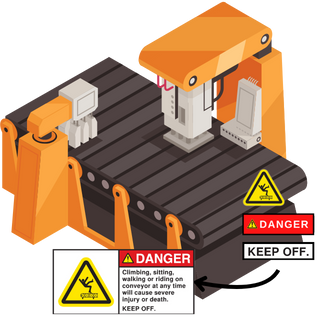
To illustrate this point, let's look at what happens when you have a large product, such as machinery found in textile plants and automobile factories. Our opinion usually is that a single large product safety label intended to be seen and read from a distance is not better than placing several smaller safety labels at points where people might encounter the hazard. For example, on a long powered roller conveyor, using several Clarion J-size roller pinch point safety labels, placing one every 10' or so along the length of the conveyor, would be better than placing one large sign on the conveyor. Why? Because the smaller and more frequently placed safety labels are going to be visible to people on a more continuous basis and at more points where they could possible interact with the hazard of the conveyor's powered rollers, so there is more of a chance the labels will be noticed when they need to be seen.

Can more than one hazard be listed on a safety label?

Yes! If you have multiple hazards in one location, a multi-hazard safety label is a perfectly good option to consider. Shown below is an example of the multi-hazard formats Clarion uses.* In this example, we've incorporated ISO-formatted symbols because we tend to advise our customers to convey their safety messages to a global audience whenever possible. Clarion can customize your product safety labels to have as many or as few text messages and symbols as you require. For more information on the use of multiple symbols, click here.

Multiple Hazard Safety Label Example

* It is interesting to note that one of the many contributions Clarion has made to the ANSI Z535 standards over the years is the proposal to include these multi-hazard formats - formats we developed in 1998. They were subsequently approved for use in Annexes that appear in both the ANSI Z535.4 Product Safety Sign and Label standard and the ANSI Z535.2 Environmental and Facility Safety Sign standard.

Your expert resource.


Trust Clarion to meet your duty-to-warn requirements with compliant safety signs and labels.


We know ANSI Z535, the standards that define best practices in safety communications. Clarion has helped advance them for more than two decades.


Our expertise is deep and genuine, having worked with 10,000+ companies across 180+ industries worldwide.


Collaborate with us to bring a new level of safety communication to your company.

No compromises.


3M Preferred Converter Logo


When it comes to safety, your signs and labels must not compromise in design and materials. Clarion is one of a handful of 3M Preferred Converters, offering our customers the finest adhesives, base materials and overlaminates in the world.


Always there to be seen.